
Pros and Cons of Living in Amarillo, TX: An Honest Relocation Guide
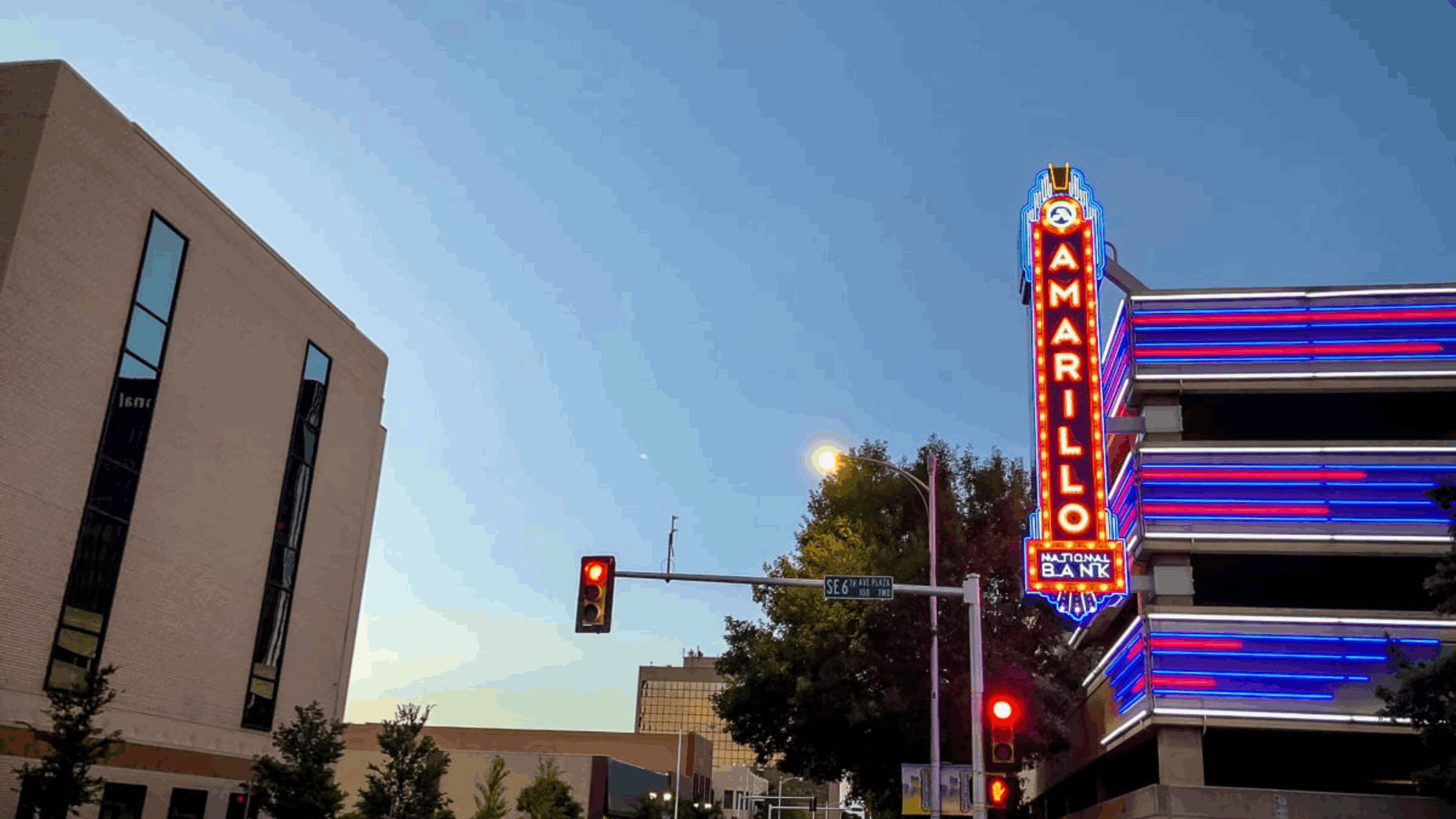
Amarillo is one of the last places in Texas where a working household can buy a three-bedroom house on a single income. It is also windy, isolated, and 360 miles from the nearest metroplex. Here is the honest ledger on both sides, so you can decide whether the trade is worth it.
In this guide
Quick verdict
Amarillo sits at roughly 3,600 feet on the High Plains of the Texas Panhandle, closer to Denver, Albuquerque, and Oklahoma City than to Dallas or Houston. About 200,000 people live here, with a median age near 34, and the city functions as the commercial hub for a region spanning the Texas Panhandle, eastern New Mexico, and the Oklahoma Panhandle.
The decision usually comes down to one question: how much do you value affordability and a short commute relative to climate comfort and access to a big-city amenity base? If the answer is "a lot," Amarillo delivers more than almost any other Texas city. If the answer is "not much," the wind alone will wear you down.
| Factor | How Amarillo rates |
|---|---|
| Housing cost | Excellent — roughly 42% below the national average |
| Overall cost of living | Strong — around 18% below national, 13% below the Texas average |
| Commute | Excellent — most cross-town trips run 15–20 minutes |
| Job market | Good but concentrated — strong in energy, ag, defense, healthcare |
| Weather | Mixed — four real seasons, but relentless wind and serious hail risk |
| Property taxes | Weak — effective rates above the Texas median |
| Outdoor recreation | Better than expected — Palo Duro Canyon is 30 minutes away |
| Big-city amenities | Limited — regional, not metropolitan |
The pros of living in Amarillo
1. Housing is genuinely affordable, not just "affordable for Texas"
This is the headline, and it is not marketing. Depending on which data source you use, the median sale price in Amarillo currently lands somewhere between roughly $212,000 and $285,000, with most credible trackers clustering in the $235,000–$250,000 range. Compare that to Frisco at around $729,000, Austin near $544,000, or Dallas around $420,000.
What that buys in practical terms: a 1,900-square-foot brick home on a real lot in an established southwest neighborhood, with a garage and a yard, for what a one-bedroom condo costs in central Austin. New construction starts in the low $200s. The average rent runs about $1,011 a month.
The second-order effect matters more than the price itself. In Amarillo, a household earning $85,000 is comfortably middle class with room to save. In most Texas metros, that same income is stretched.
2. You can cross the entire city in under 20 minutes
Amarillo is laid out on a grid with I-40 running east-west, I-27 running south, and Loop 335 circling the perimeter. There is no meaningful rush hour by metro standards. A commute from a southwest neighborhood to downtown, the medical district, or the industrial corridor is typically 15 to 20 minutes.
People relocating from Dallas-Fort Worth, where the average commute runs past 35 minutes each way, routinely describe this as the single biggest quality-of-life upgrade — bigger than the housing savings. Two hours a day returned to you is roughly 500 hours a year.
3. The employment base is unusually durable
Amarillo's economy is not a single-industry town, and the industries it does have are recession-resistant by nature. The largest employers include:
- CNS Pantex — the nation's primary facility for nuclear weapons assembly, dismantlement, and surveillance, employing roughly 4,600 people and overseen by the Department of Energy. It is now the area's top private-sector employer.
- Tyson Foods — one of the largest beef processing plants in the country, with about 4,000 employees.
- Bell Textron — helicopter production, roughly 900 workers, including assembly of military aircraft.
- Xcel Energy, BNSF Railway, Affiliated Foods, Owens Corning, Cargill, Gestamp — energy, logistics, food distribution, and manufacturing.
- BSA Health System and Northwest Texas Healthcare System — the regional medical anchors, with Northwest alone employing around 2,150.
- Amarillo ISD and the City of Amarillo — large, stable public employers.
Agriculture generates more than $4 billion annually across the Panhandle and employs over 33,000 people regionally. A $670 million Producer Owned Beef facility is under construction. National security work, food production, and electricity generation do not evaporate in a downturn the way tech or discretionary retail does.
4. No state income tax, and the savings actually compound here
Texas is one of seven states with no personal income tax. That advantage exists statewide, but it goes further in Amarillo because your other costs are lower. A $150,000 salary in Amarillo has purchasing power comparable to well over $185,000 in Austin.
5. Palo Duro Canyon is 30 minutes from your driveway
The second-largest canyon in the United States sits just southeast of the city. Palo Duro Canyon State Park offers more than 30 miles of trails for hiking, mountain biking, and horseback riding, plus camping and the well-known Lighthouse Trail to a freestanding rock formation. In summer, the outdoor musical TEXAS runs in the canyon's amphitheater.
For a city on flat plains, this is a genuinely unexpected amenity. Most residents treat it as a weekend default rather than a tourist stop.
6. Healthcare punches above the city's weight
Because Amarillo serves a multi-state region with no competing metro nearby, its medical infrastructure is sized for a much larger population. Two full hospital systems plus the Texas Tech University Health Sciences Center at Amarillo — with programs in medicine, nursing, pharmacy, pharmaceutical sciences, and physical therapy — mean specialist care that a city of 200,000 would not otherwise support. Healthcare costs run roughly 18% below the national average.
7. Route 66 culture and a real civic identity
The Sixth Street Historic District is the only publicly designated stretch of Route 66 inside the city, and it functions as an actual neighborhood of antique shops, bars, live music venues, and restaurants rather than a museum piece. Downtown has been steadily revitalized, anchored by Hodgetown ballpark, home of the Double-A Amarillo Sod Poodles. The city has a specific identity and is not interchangeable with any suburb in the state.
The cons of living in Amarillo
1. The wind is not an exaggeration
Amarillo is among the windiest cities in the United States. This is not a seasonal inconvenience — it is a daily fact of life, and it is the number one complaint from transplants. Spring is worst, with sustained winds that make outdoor dining unpleasant and dust events common.
Practical consequences: patio furniture needs weight, trampolines end up in neighbors' yards, fences take a beating, and any home improvement involving shingles or siding should be specified for high wind. Some people stop noticing after two years. Some never do.
2. Hail is a real and expensive risk
The Panhandle sits in an active hail corridor. Severe hailstorms capable of totaling roofs and vehicles occur with enough regularity that homeowners insurance premiums run higher than the low home prices would suggest, and deductibles are often structured as a percentage of insured value rather than a flat dollar amount.
Budget for this before you close. Ask any seller when the roof was last replaced and whether it was an insurance claim. Ask your agent for a quote from a local carrier, not a national online estimate — the national estimate will be wrong.
3. Property tax rates are above the Texas median
The low purchase price is partially offset here. Amarillo's median effective property tax rate runs around 1.58% in Potter County against a Texas median near 1.48% and a national median near 1.02%. Some analyses put the blended Potter/Randall figure closer to 1.92%.
Rates also vary sharply within the city. The 79104 ZIP code carries a median effective rate near 1.98%, while 79108 sits around 1.29% — a spread of nearly 0.7 percentage points inside the same city, driven by school district and assessment boundaries.
4. You are genuinely far from everything
Dallas is about 360 miles away. Denver is roughly 425. Albuquerque is around 290. Amarillo is closer to parts of four other states than it is to Houston or San Antonio. Rick Husband Amarillo International Airport serves the city, but flight options are limited and generally require a connection.
If you have family in another metro, or a job that requires frequent travel, factor in connecting flights and long drives. Spontaneous weekend trips to a major city are not on the table.
5. Retail, dining, and entertainment are regional, not metropolitan
Amarillo is well-served for a city its size — precisely because it serves a much larger region — but "well-served for its size" has a ceiling. You will find solid local restaurants, a decent brewery scene, museums, a zoo, a symphony, and minor league baseball. You will not find a major concert circuit stop every month, a wide range of international cuisine, or the density of options a metro provides.
6. The job market is concentrated at the top
The flip side of a durable employment base is a narrow one. If your career is in aerospace manufacturing, energy, agriculture, food processing, logistics, healthcare, education, or national security, Amarillo has a real ladder for you. If it is in finance, technology, marketing, law at scale, or specialized professional services, the ladder has fewer rungs and you may hit a ceiling faster than you would in a metro.
Remote workers largely sidestep this problem, and that is a major reason the market has drawn relocation interest.
7. Winter is not mild
Amarillo is not East Texas. Winter brings genuine cold, occasional blizzard conditions, and ice storms that shut down highways. The elevation and exposure mean wind chill is a serious factor. On the other side of the ledger, low humidity makes summer heat considerably more tolerable than in Dallas or Houston, and the city gets four distinct seasons instead of eight months of summer.
8. The market moves slowly by Texas standards
Homes in Amarillo typically sit 60 to 70 days before going under contract, and a meaningful share of active listings take price reductions. For buyers, that is leverage. For sellers, it means pricing accurately from day one matters more here than in a fast metro where a mispriced home still gets absorbed.
Who Amarillo fits — and who it doesn't
| Amarillo works well for | Amarillo is a harder fit for |
|---|---|
| First-time buyers priced out of metro Texas | Buyers who need a deep, specialized job market |
| Remote workers optimizing cost of living | Frequent business travelers needing direct flights |
| Families wanting space, a yard, and a short commute | Anyone who strongly dislikes wind or cold |
| Healthcare, energy, ag, defense, and manufacturing careers | People who want metropolitan dining and nightlife |
| Retirees seeking low carrying costs and good specialist care | Households needing close proximity to family in other states |
| Buyers wanting acreage within 20 minutes of town | Buyers expecting fast appreciation and quick resale |
The advice most locals give newcomers
Rent for six months before you buy, and get through one spring. Spring is the windiest, most volatile stretch of the year and the truest test of whether the climate is livable for you. If April doesn't break you, the rest of the year won't.
Thinking about a move to Amarillo?
Neighborhood fit, school district boundaries, and insurance exposure vary more inside this market than newcomers expect. Talk to an agent who works it daily before you narrow your search.
[PARTNER CTA — insert brokerage name, agent, phone, email, and site URL]
Frequently asked questions
Is Amarillo, TX a good place to live?
For buyers prioritizing affordability, short commutes, and a stable job base in energy, agriculture, healthcare, defense, or manufacturing, Amarillo is one of the strongest values in Texas. It is a weaker fit for people who need metropolitan amenities, frequent direct flights, or a deep white-collar job market.
What is the biggest downside of living in Amarillo?
The wind, consistently. Amarillo is among the windiest cities in the country and it is a daily condition, not a seasonal one. Hail risk and the resulting insurance costs are the second most common complaint.
How expensive is it to live in Amarillo?
Overall cost of living runs roughly 18% below the national average and about 13% below the Texas average. Housing is around 42% cheaper than the national average, utilities about 11% less, groceries roughly 6% less, and healthcare about 18% less.
Is Amarillo a buyer's or seller's market?
Conditions have favored buyers recently, with roughly three months of supply, 60–70 days on market, and a significant share of listings taking price reductions. Well-priced homes in desirable southwest neighborhoods still move quickly.
What are the main employers in Amarillo?
CNS Pantex, Tyson Foods, Bell Textron, Xcel Energy, BNSF Railway, Affiliated Foods, BSA Health System, Northwest Texas Healthcare System, Amarillo ISD, and the City of Amarillo.
How far is Amarillo from Dallas?
Roughly 360 miles, about a five-and-a-half hour drive. Amarillo is geographically closer to parts of Oklahoma, New Mexico, Kansas, and Colorado than to most major Texas cities.
Does it snow in Amarillo?
Yes. Amarillo gets real winters with cold temperatures, periodic snow, occasional blizzard conditions, and ice events. Low humidity makes summers noticeably more comfortable than in central or east Texas.
Market figures reflect multiple third-party data sources and change over time. Texas is a non-disclosure state, so reported sale prices vary between providers. Verify current values, tax rates, and insurance costs for any specific property.
FROM OUR BLOG

Golf Courses in Amarillo, TX: The Complete Guide
Golf Courses in Amarillo, TX: The Complete Guide Amarillo is one of the best-kept secrets in Texas golf, and the reason is simple: the City of Amarillo owns two full 36-hole complexes and runs them well. That is 72 holes of municipal golf in a city of 200,000 — a ratio almost no metro in the s

Schools in Amarillo, TX: A Complete Guide to Districts, Campuses, and Ratings
Schools in Amarillo, TX: A Complete Guide to Districts, Campuses, and Ratings Amarillo is served by five public school districts, two charter networks, and four established private schools. The district boundaries do not follow city limits, neighborhood names, or any intuitive landmark — which
25 Things Locals Know About Living in Amarillo
25 Things Locals Know About Living in Amarillo Every city has a layer of knowledge that does not show up in relocation guides — the stuff you learn in the first two years, usually the hard way. Here is Amarillo's, from someone-who-lives-here perspective: the wind, the hail, the sunsets, the food