
Living in Amarillo vs. Canyon, TX: Which Is Better?
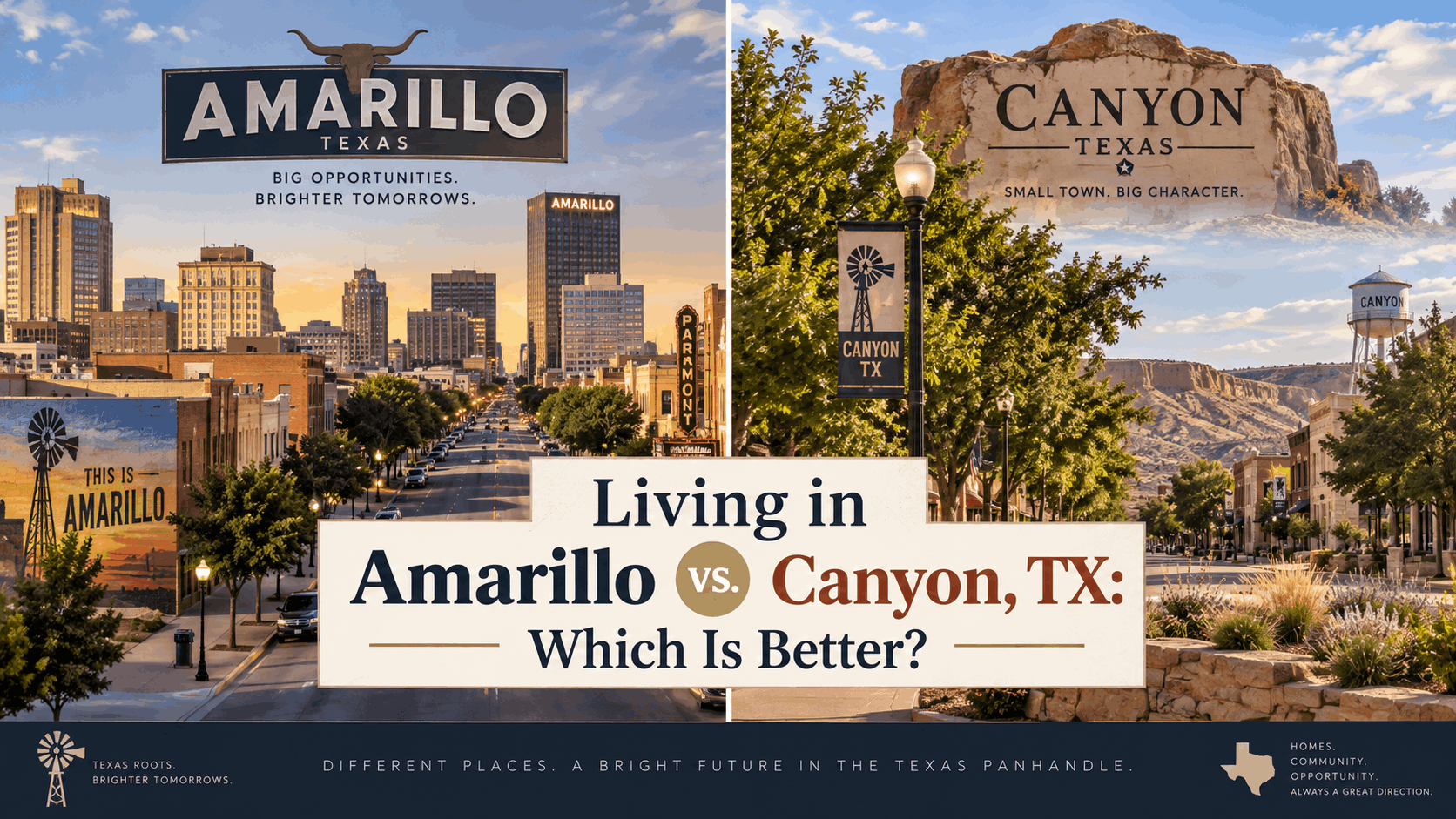
Canyon costs more per home than Amarillo, has a stronger school district, a university, and Palo Duro Canyon at its doorstep. Amarillo has more inventory, more jobs, more retail, and lower entry prices. The 15-minute drive between them is short enough that most buyers can genuinely choose either — which is exactly why this decision stalls so many relocations.
Compared here
Quick comparison
| Amarillo | Canyon | |
|---|---|---|
| Population | ~200,000 | ~24,000 |
| County | Potter and Randall | Randall |
| Median home price | ~$235,000–$250,000 | ~$280,000–$315,000 |
| Days on market | ~60–70 days | ~35 days |
| School district | Amarillo ISD (parts in Canyon ISD) | Canyon ISD |
| University | Amarillo College, TTUHSC | West Texas A&M University |
| Inventory | Deep — 800–1,100 active listings | Thin |
| Typical lot size | Standard suburban | Larger; half-acre-plus common in newer areas |
| USDA 0%-down eligible | Generally no | Yes — designated rural area |
| Retail and dining | Regional hub | Small-town downtown plus a 15-minute drive |
The counterintuitive headline: the smaller town is the more expensive one. Canyon's median home price runs roughly $315,000 against Amarillo's $238,000, and Canyon homes sell in about half the time. That is not a quirk — it is the price of Canyon ISD, larger lots, and constrained inventory in a town people actively want to move into.
Housing and home prices
Amarillo
Amarillo's advantage is breadth. With 800 to 1,100 active listings depending on season and roughly three months of supply, there is something in nearly every price band, style, and vintage — 1920s Wolflin brick, 1970s Puckett ranch homes, 1990s Sleepy Hollow two-stories, and current new construction. Entry-level inventory starts well under $200,000 in some areas, and new construction starts around $211,000.
Conditions favor buyers: 60 to 70 days on market, a quarter to a third of listings taking price reductions, and homes selling around 3% below list on average. That is real negotiating leverage.
Canyon
Canyon's market runs the opposite way. Inventory is thin, homes sell in roughly 35 days, and prices run meaningfully higher. Median home values sit somewhere in the $280,000–$315,000 range depending on the source, with newer construction pushing higher.
What you get for the premium: larger lots, newer average housing stock, and Canyon ISD. What you give up: selection and negotiating room. In a market moving at 35 days, waiting for the perfect house is a losing strategy.
Schools
This is the single biggest driver of the price gap, and it deserves a careful answer.
Canyon ISD is consistently regarded as the strongest district in the Amarillo region and has been named the top district in the area by third-party rating services. It serves the city of Canyon and — critically — a substantial portion of southwest Amarillo.
Amarillo ISD is the region's largest district, covering roughly 70 square miles across Potter and Randall counties. It is a large urban district with the range of outcomes that implies across individual campuses.
Commute and location
Canyon sits roughly 15 to 20 minutes south of Amarillo on I-27, and the drive is genuinely uncomplicated — a straight interstate run with no congestion. From Canyon, most Amarillo destinations are reachable in 15 to 20 minutes, including downtown, the medical district, Westgate Mall, and Rick Husband Amarillo International Airport.
Practically, this means a Canyon address does not meaningfully penalize an Amarillo commute. The reverse is also true: living in southwest Amarillo puts you close to Canyon's amenities.
One common household pattern makes the location decision easier: when one spouse works in Amarillo and the other works in Canyon — a frequent situation for West Texas A&M faculty, Canyon ISD staff, and medical professionals — a location between the two splits the difference for both.
The one real trade-off: Canyon puts you meaningfully closer to Palo Duro Canyon State Park, which for outdoor-oriented households is a daily-use amenity rather than a weekend trip.
Acreage and lot sizes
Canyon and its surroundings are the stronger answer for buyers who want land.
- Inside Canyon city limits, newer developments include half-acre minimum lots — Spring Canyon's Phase 3, for example, sits inside city limits with half-acre minimums, canyon views, and a $500 annual HOA fee, with minimum home sizes of 2,100 to 3,500 square feet.
- Between Amarillo and Canyon, acreage tracts from 1 to 5+ acres are common along the I-27 corridor and TX-217, many in Canyon ISD.
- South and east of Canyon, larger parcels of 5 acres and up support horses, shops, and barndominiums, often with fewer restrictions.
Inside Amarillo, standard suburban lots are the norm. Acreage near Amarillo generally means going outside city limits — Bushland to the west, or Timbercreek Canyon, River Falls, and Lake Tanglewood to the southeast.
Important practical note: acreage properties in both areas typically require well and septic rather than municipal water and sewer. Some Canyon-area developments offer city water with buyer-installed septic. Inspect both systems separately, and confirm whether a well exists or must be drilled — drilling is a five-figure expense that buyers routinely fail to budget for.
New construction
| Community | Location | District | Starting range |
|---|---|---|---|
| Tierra Blanca at Williams Ranch | Canyon | Canyon ISD | Low $200s |
| Spring Canyon | Canyon city limits | Canyon ISD | Lots; half-acre minimum |
| Clifton Ridge | Canyon | Canyon ISD | Custom / land tracts |
| Beacon Pointe | SW Amarillo | Canyon ISD | From ~$229,000 |
| Hillside Terrace | SW Amarillo | Canyon ISD | From ~$272,000 |
| Heritage Hills | SW Amarillo | Canyon ISD | Mid $200s–$400K |
| Tradewind Square | SE Amarillo | Amarillo ISD | From ~$211,000 |
| Pinnacle | SW Amarillo | Canyon ISD area | $400K–$700K+ |
Canyon's new construction is concentrated in Tierra Blanca, Spring Canyon, and Clifton Ridge, with plans generally in the 1,250 to 2,300 square foot range starting in the low $200s. Amarillo's new construction is broader and spans a wider price band.
The USDA advantage in Canyon
This is the most financially consequential difference between the two markets and it is frequently overlooked. Canyon is designated a USDA-eligible rural area, which means qualified buyers can finance a home there through the USDA Rural Development program with 0% down payment.
For a buyer with strong income and credit but limited savings, this can be the difference between buying new construction now and renting for another two years. It is one of the few paths to a new home with no down payment, and it is a real reason Canyon draws buyers who assumed they were priced out.
Lifestyle and amenities
Canyon
- Historic courthouse square dating to 1909, functioning as an actual downtown with local shops and restaurants
- West Texas A&M University — roughly 10,000 students, bringing athletics, arts programming, and cultural events
- Panhandle-Plains Historical Museum, the largest history museum in Texas
- Palo Duro Canyon State Park minutes away, plus the summer TEXAS outdoor musical
- A genuinely small-town social environment — people know their neighbors and their children's teachers
- Ongoing commercial expansion along the VFW corridor
Amarillo
- Regional retail including Westgate Mall and the full complement of national chains
- Two hospital systems plus the Texas Tech University Health Sciences Center
- Hodgetown ballpark and the Double-A Sod Poodles
- Route 66 Historic District on Sixth Street, with the region's concentrated nightlife
- Museums, a symphony, community theater, the Discovery Center, zoo, and Wonderland
- Rick Husband Amarillo International Airport
The honest framing: Canyon offers community depth, Amarillo offers option breadth. If you want to run into people you know at the grocery store, Canyon delivers that. If you want the grocery store to have everything you need, Amarillo does.
Jobs and economy
Amarillo holds nearly all of the region's large employers: CNS Pantex (~4,600 employees), Tyson Foods (~4,000), Northwest Texas Healthcare System (~2,150), Bell Textron (~900), Xcel Energy, BNSF Railway, Affiliated Foods, BSA Health System, and Amarillo ISD.
Canyon's economy centers on West Texas A&M University, Canyon ISD, retail trade, and tourism driven by Palo Duro Canyon. Randall County's employment is led by retail trade with over 6,400 jobs, followed by accommodation and food services.
Because the commute between the two is 15 to 20 minutes, this rarely forces the housing decision. Nearly everyone living in Canyon who works at Pantex, Tyson, or Bell simply drives — and that drive is shorter than a typical intra-city commute in DFW or Houston.
Which should you choose?
| Choose Canyon if... | Choose Amarillo if... |
|---|---|
| Canyon ISD is your top priority and you want to live in the district's core | You want maximum inventory and negotiating leverage |
| You want a larger lot or half-acre-plus | Your budget is tighter — entry prices are meaningfully lower |
| You qualify for USDA 0%-down financing | You want to be close to retail, healthcare, and the airport |
| You want a genuine small-town community | You want historic architecture or an established neighborhood |
| Palo Duro Canyon access matters daily, not occasionally | You want a broader range of home styles and vintages |
| You or a spouse works at WTAMU or Canyon ISD | You want the shortest possible commute to Pantex, Tyson, or the hospitals |
The option most buyers overlook
Southwest Amarillo in Canyon ISD is frequently the best of both. You get the district, more inventory than Canyon offers, a shorter commute to Amarillo employers, and generally lower prices than comparable Canyon homes — while staying 15 minutes from Canyon's square and Palo Duro. Beacon Pointe, Hillside Terrace, Heritage Hills, Westover, and the Greenways corridor all sit in this overlap.
If the school district is the real driver of your Canyon interest, tour southwest Amarillo before you commit to the premium.
Still deciding between Amarillo and Canyon?
The school district boundary is the deciding factor for most families, and it does not follow city limits. Get the specific addresses verified before you narrow your search.
[PARTNER CTA — insert brokerage name, agent, phone, email, and site URL]
Frequently asked questions
Is Canyon, TX a good place to live?
Canyon is widely considered one of the most desirable places to live in the Texas Panhandle, driven by Canyon ISD, West Texas A&M University, proximity to Palo Duro Canyon, and a genuine small-town community. Home prices run higher than Amarillo's and inventory is thinner.
Is Canyon more expensive than Amarillo?
Yes. Canyon's median home price runs roughly $280,000–$315,000 against Amarillo's $235,000–$250,000, and Canyon homes sell in about half the time — roughly 35 days versus 60–70.
How far is Canyon from Amarillo?
About 15 to 20 minutes south on I-27, with no meaningful congestion. Most Amarillo destinations are within a 20-minute drive of Canyon.
Is Canyon ISD better than Amarillo ISD?
Canyon ISD is consistently rated the strongest district in the Amarillo region. Importantly, a substantial portion of southwest Amarillo is served by Canyon ISD despite having an Amarillo address, so living in the city of Canyon is not required to access the district.
Can you get a 0% down payment loan in Canyon, TX?
Canyon is a USDA-eligible rural area, so qualified buyers may finance a home there through the USDA Rural Development program with no down payment. Eligibility depends on income limits and the specific property address.
Where can you find acreage between Amarillo and Canyon?
The I-27 and TX-217 corridors between the two cities have numerous tracts from 1 to 5+ acres, many in Canyon ISD. Developments like Spring Canyon offer half-acre minimum lots inside Canyon city limits. Most acreage properties require well and septic systems.
Price figures reflect third-party data sources and change over time. Texas is a non-disclosure state, so reported sale prices vary between providers. School district assignments and USDA eligibility must be verified for each specific address.
FROM OUR BLOG

Golf Courses in Amarillo, TX: The Complete Guide
Golf Courses in Amarillo, TX: The Complete Guide Amarillo is one of the best-kept secrets in Texas golf, and the reason is simple: the City of Amarillo owns two full 36-hole complexes and runs them well. That is 72 holes of municipal golf in a city of 200,000 — a ratio almost no metro in the s
Schools in Amarillo, TX: A Complete Guide to Districts, Campuses, and Ratings
Schools in Amarillo, TX: A Complete Guide to Districts, Campuses, and Ratings Amarillo is served by five public school districts, two charter networks, and four established private schools. The district boundaries do not follow city limits, neighborhood names, or any intuitive landmark — which
25 Things Locals Know About Living in Amarillo
25 Things Locals Know About Living in Amarillo Every city has a layer of knowledge that does not show up in relocation guides — the stuff you learn in the first two years, usually the hard way. Here is Amarillo's, from someone-who-lives-here perspective: the wind, the hail, the sunsets, the food