
Updated October 31, 2026
On October 29, 2026, the French newspaper Le Monde ran an English-language feature titled "Amarillo's battle over water and data centers: 'We believe God entrusted us with this land to take care of it.'" It introduced readers worldwide to a debate Panhandle families have been having for more than a year: what happens when the AI boom arrives in a region whose groundwater is declining.
The Le Monde story centers on residents, many from families who settled the High Plains generations ago, who see protecting water as a duty. On the other side are city leaders and developers who point to jobs, tax revenue, premium water rates, and new cooling technology. This article covers both sides with the latest local reporting: the Fermi America "Project Matador" water agreement, Google's data center campus in Claude, the summer 2026 drought restrictions, and what all of it means if you own, buy, or sell a home in the Amarillo area.
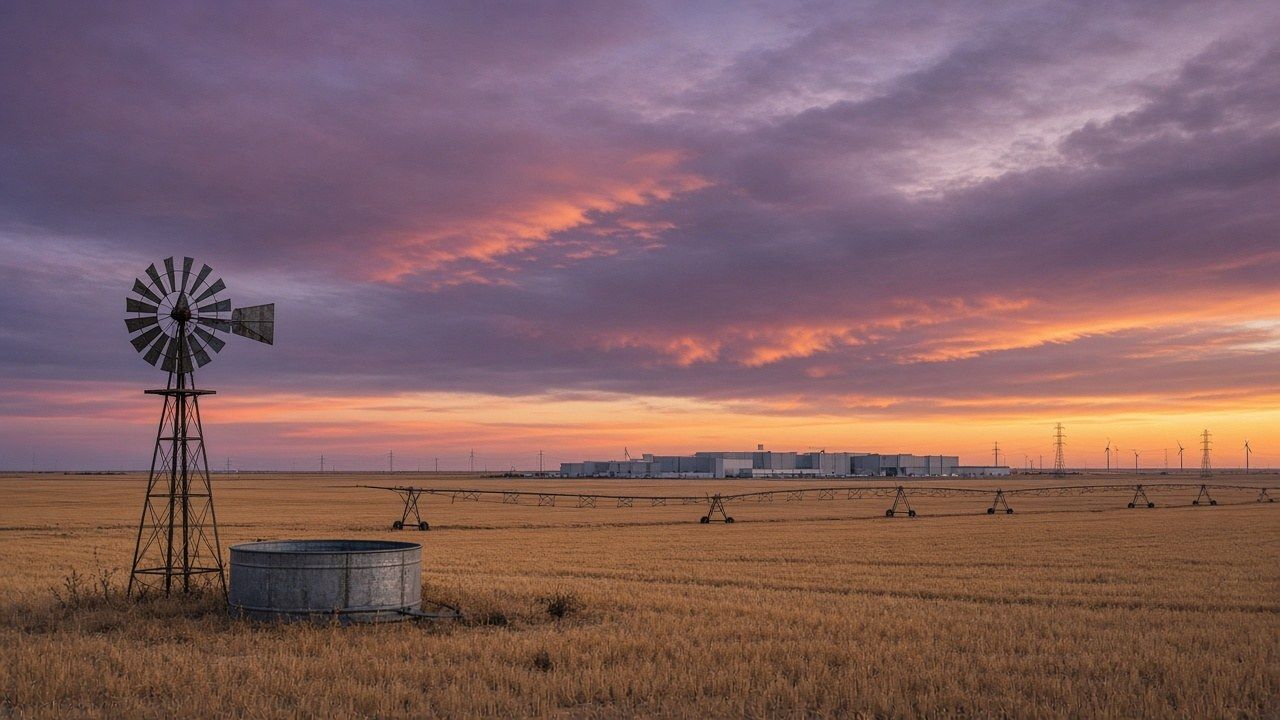
Update as of late Oct 31, 2026: Public reporting still showed no announced TensorWave lease closing, second extension, or project-level construction financing close as of the Oct 31 deadline; either party could terminate if conditions were unmet. Verify the latest company filings before citing a closed lease.
Key Takeaways
- The flashpoint is Fermi America's Project Matador, a planned 5,800-acre private-grid energy and AI campus in Carson County next to Pantex. Amarillo agreed in October 2025 to sell it up to 2.5 million gallons of water per day at twice the industrial rate ($8.72 per 1,000 gallons), with an option to go to 5 MGD.
- Actual use so far is small. In July 2026, Fermi used about 310,000 gallons for the whole month, ranking 386th among Amarillo's top 400 water customers, about the same as a coffee shop or convenience store, according to the city.
- Amarillo's water is about 87% groundwater, mostly from the Ogallala Aquifer, which is falling across much of the Panhandle. A Carson County monitoring well read about 423 feet to water on October 27, 2026, roughly 1.6 feet lower than a year earlier.
- Summer 2026 tested the system. Amarillo entered Stage 1 voluntary drought restrictions on August 17, 2026, for the first time since 2022, then lifted them September 11 after the city reservoir recovered above 80%.
- City leaders say agriculture, not data centers, drives aquifer decline. Critics answer that every added gallon matters in a closed aquifer and that accountability terms are too weak.
- The state is watching. In September 2026, Texas AG Ken Paxton opened investigations into data center developments, including some in Potter and Randall counties, that did not answer a state water-use survey.
What Le Monde Reported
Le Monde's piece (October 29, 2026) describes a region in the middle of a transition. Route 66 landmarks like Cadillac Ranch, with its ten Cadillacs buried nose-down since 1974, now share the horizon with wind turbines and data centers under construction. The paper profiles residents such as retired farmer Phil Sanders, whose land lies about 140 km (roughly 87 miles) north of Amarillo. Many of these residents frame their opposition as stewardship of land their families settled after the Red River War of 1874. The headline quote, "We believe God entrusted us with this land to take care of it," sums up that view.
The article also captures the Panhandle's working economy: the cattle feedlots and packing plants whose smell locals jokingly call "the smell of money," and a downtown split by the railroad. Its core question is one many residents share: how much water should new, very large industrial users be allowed to draw from a landscape already shaped by irrigated agriculture and energy development?
Note: Le Monde's full article is behind a subscription. The summary above draws on the headline and published summaries of the piece. Read the original at Le Monde.
The Projects at the Center of the Debate
| Project | Location | Developer | Water source & amount | Status (Oct 2026) |
|---|---|---|---|---|
| Project Matador | Carson County, next to Pantex (Texas Tech University System land) | Fermi America (co-founded by former Gov. Rick Perry) | City of Amarillo contract: up to 2.5 MGD, option to 5 MGD; Fermi plans closed-loop, air-cooled systems | Under construction; first tenant lease (TensorWave) pending; NRC reviewing 4 proposed reactors |
| Project Llano | Claude, Armstrong County | Google, built by Crusoe | Closed-loop cooling, about 2M gallons/year per building once running; water from nearby private sources | Six buildings under construction; first handed over early 2027 |
| Pampa campus | Near Pampa, Gray County | APR Energy | Reported start of about 1.5 MGD | Planned / in development |
| Downtown edge data center | Downtown Amarillo | Duos Edge | Small edge facility | Announced |
MGD = million gallons per day. Sources: City of Amarillo, Amarillo Tribune, KFDA NewsChannel 10, KAMR MyHighPlains, ABC 7 Amarillo, Texas Tribune.
Inside the Fermi Water Agreement
After a heated public process, including a September 2025 protest at the Potter County courthouse and more than two hours of mostly opposing public comment on October 14, 2025, the Amarillo City Council approved the Fermi water supply agreement on second reading on October 28, 2025. It was signed October 30, 2025. Here is what the deal does:
| Term | What the agreement / city says |
|---|---|
| Volume | Up to 2.5 million gallons per day, with an option to rise to 5 MGD |
| Price | 2× the standard industrial rate, reported at $8.72 per 1,000 gallons |
| Infrastructure | Fermi pays to build two new wells in the city's Carson County Well Field, connecting pipelines, and a backup generator for an existing pump station, all deeded to the city |
| Deadline | The city's duty to supply depends on that infrastructure being finished and dedicated by January 2027 |
| Initial build cost | City engineers estimated $10–12 million for the first 2.5 MGD phase |
| Revenue | Deposited into the city's Water and Sewer Fund for maintenance and capital projects |
| Residential rates | The city says the agreement will not affect residential water rates |
| Water rights | Mayor Cole Stanley has stressed the city sold water service, not a water right |
The city also notes that the Fermi site is outside Amarillo city limits, so Amarillo has no authority over the land sale or development approvals there. It controls only whether it sells water.
The case for the deal
- Scale context: Mayor Stanley noted that even at 10 MGD, about 3.6 billion gallons a year, Fermi would use roughly 0.32% of the approximately 1.1 trillion gallons used each year across the 26-county region. Fermi puts its expected share at about 0.13% of Panhandle water use.
- Comparable users: The mayor compared the request with existing large industrial customers, such as a beef plant at about 3 MGD and a paper company at about 1.8 MGD. The city's typical daily demand is about 50 MGD.
- Technology: Fermi says it plans closed-loop cooling with air-cooled condensers designed to use about 80% less water than traditional systems, relying heavily on non-potable and recycled water. It says 7.2 miles of company-funded water line is already built.
- Jobs and youth retention: Supporters at council meetings argued the project could keep young people in the Panhandle. As one resident put it, "This project will keep our children and grandchildren in Amarillo."
The case against
- A finite aquifer: Opponents say the Ogallala is effectively being mined faster than it recharges, so any new long-term demand adds pressure, whatever the percentage.
- Room to expand: Early discussions raised the possibility of 10 MGD over time. Critics worry that today's small numbers are a starting point.
- Accountability: Councilmember Les Simpson said in October 2025 that the draft agreement lacked enough ways to hold Fermi accountable. Residents asked for more town halls and environmental review.
- Neighbors' property: Carson County resident Robin Hart told the council her family learned about construction across the road only when trucks arrived, and said she believes it has hurt the value of land meant for her grandson.
- Bigger footprint: Beyond water, residents have raised concerns about noise, air permits, traffic, and Fermi's plan for on-site nuclear power.
How Much Water Is Fermi Actually Using?
As of late summer 2026, Fermi was nowhere near its contract limit. Assistant City Manager Donny Hooper told the council in August 2026 that Fermi Inc. used 310,000 gallons in July, ranking 386th among the city's top 400 water users. At full contract volume, 2.5 MGD would be about 75 million gallons a month, roughly 240 times July's use.
Project timing will drive future demand. Fermi announced its first tenant, AI cloud company TensorWave, with a lease for 222 MW and phased delivery planned from late 2027 into 2028. As of October 28, 2026, financial press reported that the lease's closing deadline was October 31 and that project financing had not yet been announced. Fermi's stock had fallen sharply during 2026. Separately, the U.S. Nuclear Regulatory Commission released a draft environmental impact statement on October 9, 2026, that preliminarily recommends licenses for four AP1000 reactors at the site. Public comments run through November 23, 2026, and Fermi targets 2032 for its first reactor.
Bottom line: today's water draw is small. The long-term question is how much water the campus uses at full build-out, and whether cooling and recycling work as promised.
Where Amarillo's Water Comes From
| Source | Role |
|---|---|
| City well fields (Ogallala Aquifer) | Wells in Carson, Deaf Smith, Potter, and Randall counties. Groundwater makes up about 87% of Amarillo's drinking water. |
| Canadian River Municipal Water Authority (CRMWA) | Regional supplier that blends groundwater with Lake Meredith water. CRMWA has recently run about 80% wells / 20% lake. Amarillo's allocation is about 36 MGD. |
| Lake Meredith | Surface water, about 13% of the city's mix. The lake was 44.2% full on October 7, 2026, vs. 47.9% a year earlier. |
| Water rights portfolio | About 259,842 acres of water rights, mostly undeveloped and held for future supply |
| City reservoir | 500-million-gallon contingency reservoir, fed by the CRMWA line |
The summer 2026 drought test
In August 2026, heat and wind pushed demand to 80–85 MGD, well above the usual 50 MGD. Amarillo was drawing about 48 MGD into its plant while only 36 MGD came in from CRMWA. The reservoir fell below 60%, which triggered Stage 1 of the 2024 Drought Contingency Plan on August 17, 2026, a voluntary odd/even outdoor watering schedule. The reservoir bottomed out near 52%. Stage 2, which brings mandatory limits and fines, starts at 50%.
Help came from several directions. Amarillo ISD, Canyon ISD, Amarillo College, and city parks and golf courses cut back. CRMWA managed regional demand, and the City of Lubbock shared part of its CRMWA allocation. Late-September storms brought 7.79 inches of rain for the month. The city lifted Stage 1 on September 11, 2026.
That episode shaped the data center debate. At the FY2026/27 budget hearing, a resident asked where the concern had been a year earlier during the Fermi vote. Mayor Stanley said the council believed it made "a pretty good business decision." Councilmember David Prescott said area water shortages were "not because of data centers" and blamed aquifer drops of 5 to 7 feet in some areas on agricultural overproduction. The adopted 11% water and sewer rate increase was attributed to capital improvements (8%) and debt on the $60 million Hollywood Road project (3%), not to Fermi.
Google's Claude Campus: A Different Model
About 30 miles southeast of Amarillo, Google and Crusoe are building "Project Llano", a six-building campus in Claude. At a September 2026 open house, Crusoe said it uses a closed-loop system that is filled once and recirculates for about 15 years. Once running, each building should use about 2 million gallons a year, which officials compared to about 16 households. Construction water use averaged around 600,000 gallons a day during earthwork and should drop to about 275,000 gallons a day as buildings are enclosed.
The campus will run mainly on nearby wind farms, with the ERCOT grid as backup. Google has committed to 50 permanent jobs, and company figures estimate more than $850 million in local tax revenue over the project's life (about $28 million a year). More than 7,500 workers were on site in September 2026, and Crusoe acknowledged the traffic burden. Claude ISD's superintendent called the project a potential big win for the school district while noting that water and traffic concerns remain.
The State Steps In: Water-Use Reporting
Texas does not currently bar data centers from using drinking water, and until recently most did not have to report usage. That is changing. On September 23, 2026, Attorney General Ken Paxton announced investigations into hundreds of data center developments statewide, including some in Potter and Randall counties, that did not respond to the Texas Water Development Board's annual water-use survey. Fermi says it built water tracking and reporting into its plans from the start.
Both Sides at a Glance
| Issue | Supporters say | Critics say |
|---|---|---|
| Water volume | A fraction of a percent of regional use; agriculture dominates | Any new long-term draw on a declining aquifer is a cost future generations pay |
| Price | Premium rate (2×) funds city water system upgrades | No price makes up for water that doesn't come back |
| Infrastructure | Developer-funded wells and lines become city assets | New wells mean more pumping from the same aquifer |
| Technology | Closed-loop and air cooling use far less water | Promises need independent monitoring and enforceable limits |
| Economy | Construction jobs, permanent tech jobs, big tax base | Permanent jobs are few compared with the resources used |
| Community | Keeps young people in the Panhandle | Neighbors face traffic, noise, and property impacts with little notice |
What This Means for Amarillo Homeowners and Buyers
Inside city limits
- Water bills: The city says the Fermi deal does not raise residential rates. The FY2026/27 increase was tied to capital projects and debt. Watch future budget hearings.
- Landscaping: Expect conservation to stay in the picture. Drought-tolerant landscaping, smart irrigation controllers, and turf choices like buffalograss can lower bills and make a home more appealing to buyers.
- Jobs and demand: Thousands of construction workers and future operations staff add housing demand, especially rentals and starter homes in north and east Amarillo and surrounding towns.
Rural and acreage buyers (Carson, Armstrong, Potter, Randall counties)
- Well due diligence: Ask for the well's depth, recent water level, pump details, and a water quality test. You can check nearby monitoring wells on the Texas Water Development Board's Water Data for Texas site and contact the local groundwater conservation district, such as the Panhandle GCD, about spacing and production rules.
- Proximity: Look up active and planned industrial projects within a few miles of a property. Traffic, lighting, noise, and road changes can affect enjoyment and resale.
- Tax base: Large campuses can bring significant new tax revenue to small school districts and counties. That can mean better facilities, but it can also mean growth pressure.
Sellers
- Homes with water-wise landscaping, updated plumbing fixtures, and documented well records stand out to today's more water-aware buyers.
- If you are near a project site, sell on facts. Nearby employment and amenities may appeal to some buyers, while others will want distance.
Timeline: Amarillo's Water and Data Center Debate
| Date | Event |
|---|---|
| Late Sept 2025 | Residents protest the proposed Fermi water deal at the Potter County courthouse |
| Oct 14, 2025 | Council unanimously approves the first reading after more than 2 hours of public comment |
| Oct 28, 2025 | Second reading and final approval |
| Oct 30, 2025 | Water supply agreement signed |
| July 2026 | Fermi uses about 310,000 gallons for the month |
| Aug 10, 2026 | Fermi signs TensorWave lease (222 MW), pending closing |
| Aug 17, 2026 | Amarillo enters Stage 1 drought plan, its first since 2022 |
| Sept 11, 2026 | Stage 1 lifted after reservoir recovers above 80% |
| Sept 23, 2026 | Google/Crusoe open house in Claude; AG announces water-survey investigations that include Potter and Randall counties |
| Oct 9, 2026 | NRC draft environmental impact statement for Fermi's proposed reactors |
| Oct 29, 2026 | Le Monde publishes its Amarillo water feature |
| Jan 2027 | Deadline for Fermi-funded wells and infrastructure to be dedicated to the city |
Frequently Asked Questions
Is Amarillo selling its water rights to a data center?
No. The city sold water service under a contract, not water rights. Fermi can buy up to 2.5 MGD (with an option to 5 MGD) at twice the industrial rate, and it must fund new wells and lines that become city property.
Will the Fermi deal raise my water bill?
The City of Amarillo says the agreement will not affect residential water rates. The 11% water and sewer increase in the FY2026/27 budget was attributed to capital improvements and debt service, not Fermi.
How much water does Fermi use right now?
About 310,000 gallons in July 2026 by the city's count, comparable to a coffee shop or convenience store. The campus is still under construction.
Where is Project Matador?
In rural Carson County, northeast of Amarillo, next to the Pantex plant, on land leased from the Texas Tech University System. It is outside Amarillo city limits.
What is the Ogallala Aquifer, and is it running out?
The Ogallala is a huge underground aquifer under the High Plains and the main water source for Panhandle farms and cities. In much of the region it is being pumped faster than rain recharges it, so water levels keep falling. Agriculture is by far the largest user.
Do data centers use a lot of water?
It depends on the cooling design. Evaporative systems can use large amounts. Closed-loop and air-cooled systems, which Fermi and Google say they use, need far less water but more electricity. Independent reporting of real usage is the best check.
Is Amarillo under water restrictions now?
No. Stage 1 voluntary restrictions ran from August 17 to September 11, 2026. The city still encourages conservation.
What did Le Monde say about Amarillo?
Its October 29, 2026, feature describes Panhandle residents who see protecting land and water as a moral and spiritual responsibility, set against a region adding wind farms and data centers. It quotes residents including a retired farmer north of Amarillo.
Should I worry about buying a home in Amarillo because of this?
Amarillo has a large water rights portfolio and a drought plan that worked in 2026, but water is a long-term regional issue. If you buy rural acreage, put well due diligence and nearby development at the top of your checklist.
Sources
- Le Monde – Amarillo's battle over water and data centers (Oct. 29, 2026)
- City of Amarillo – Fermi Project Updates & FAQ
- City of Amarillo – Fermi America Water Supply Agreement (signed Oct. 30, 2025)
- Amarillo Tribune – How much water is Fermi America using?
- Amarillo Tribune – Council hosts marathon Q&A with Fermi
- Amarillo Globe-News – Council backs first reading of Fermi water agreement
- KAMR MyHighPlains – Mayor Stanley details Fermi agreement; residents speak up
- Amarillo Ledger – Fermi agreement raised at FY2026/27 budget hearing
- Amarillo Globe-News – Stage 1 drought plan, first since 2022
- Amarillo Tribune – Reservoir not yet recovered after a week of conservation
- City of Amarillo – Stage 1 lifted (Sept. 11, 2026)
- ABC 7 Amarillo – September rain boosts Lake Meredith
- City of Amarillo – 2025 Consumer Confidence (Water Quality) Report
- KFDA NewsChannel 10 – Construction underway on six-building Claude data center
- ABC 7 Amarillo – Potter, Randall data centers among those investigated over water-use survey
- Texas Tribune – Rural Texas casting a skeptical eye on data centers
- Fermi America – How Project Matador stacks up (company statement)
- The Inference – Fermi's TensorWave lease deadline (Oct. 28, 2026)
- TWDB Water Data for Texas – Carson County Ogallala monitoring well 0646805
- Panhandle Groundwater Conservation District – Water level management
Disclaimer: This article is for general informational purposes only and summarizes public reporting and official documents as of October 31, 2026. It is not legal, environmental, engineering, investment, or financial advice, and OnDemand Realty takes no position on any specific project. Project plans, water agreements, usage figures, rates, and regulatory status can change. Company statements are the companies' own claims. Le Monde's full article is subscription-only, so its content is summarized from the headline and published summaries. Buyers of rural property should consult the local groundwater conservation district, a licensed water well professional, and appropriate advisors before buying.
Buying or Selling in the Panhandle? Get the Local Picture
Water, growth, and new industry are changing the Amarillo market, and the right home depends on knowing the details: city water or a private well, which neighborhoods are near new job centers, and how taxes and utilities compare. OnDemand Realty helps buyers and sellers across Amarillo, Canyon, and the surrounding counties. Visit www.ondemandamarillo.com to search homes or get a free home value estimate.
FROM OUR BLOG
Tradewind Airpark Amarillo: 1- and 2-Bedroom New Homes Guide 2026
Updated October 31, 2026 Under $200,000 for a brand-new house in Amarillo? Tradewind Airpark is where that still happens. Betenbough Homes builds this southeast Amarillo community near Mirror Street and 40th Avenue, close to Tradewind Airport. Betenbough calls it the "only new home community with 1-

Town Square Amarillo New Homes: Luxury Builds in Canyon ISD (2026)
Updated October 31, 2026 Town Square is one of southwest Amarillo's most recognizable addresses. It's a planned neighborhood off Hillside and Soncy in ZIP code 79119, close to the shops and restaurants of Town Square Village and the Verdure fitness club, and it's in Canyon ISD's West Plains High Sch
Tascocita Hills Amarillo: Gated Acreage Homes by HOME By Lyons (2026)
Updated October 31, 2026 Want acreage, a gated entrance, room for a shop, and a Bushland ISD address, but still only minutes from Amarillo's medical district and shopping? That's what Tascocita Hills offers. HOME By Lyons calls it northwest Amarillo's "newest 1+ acre community." It sits outside the